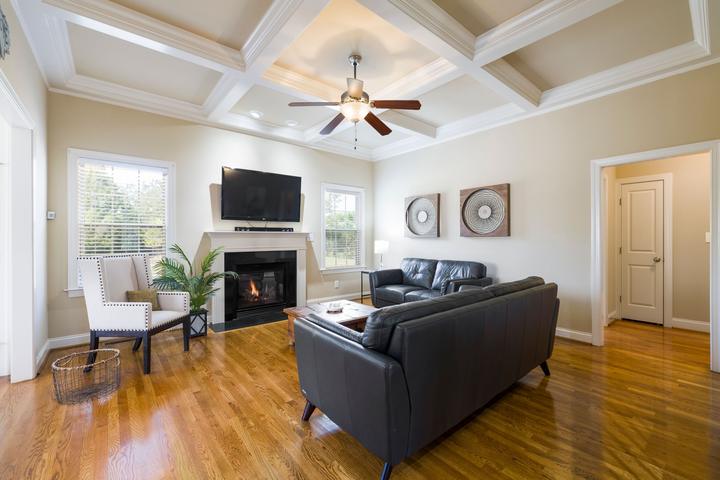
Running a Gas Line for a New Gas Fireplace
Sizing, the shutoff valve, the connector, the pressure test and the permit: the steps a new gas fireplace line goes through under the Florida code.
- Licensed & insured
- Owned and run locally
- Family owned and run
- Same-day service available
Get Your Free Inspection
Thank you for the details
We will follow up to agree on an appointment.
Prefer the phone? Call (863) 312-5129
Short version
Running a gas line for a fireplace means sizing the pipe, adding a shutoff valve and testing the result before gas flows. The 2023 Florida Building Code sets each step, from the valve in the same room to the approved connector and the pressure test. Florida law also requires a permit before most building alterations.
Jump to
The Work, Explained
What the line has to do
A gas fireplace needs a steady supply at the right pressure, not just a pipe that reaches it. Section G2413.1 of the 2023 Florida Building Code, Residential, requires piping sized to meet the maximum demand and to deliver gas to each appliance inlet at no less than the minimum supply pressure the appliance requires.
The demand is the appliance's maximum input. Section G2413.2 says the flow is the sum of the maximum input of every appliance on the line, with pipe sizing based on all of them running at once unless a diversity of load can be shown. A new fireplace joins a line that already serves a furnace, a water heater and perhaps a range, and adding it can mean the whole line is looked at again.
Pipe sizing is a calculation, not a guess
- Sealed firebox
- Gas valve and controls
- Inner pipe: exhaust out
- Outside wall
Section G2413.3 lets the pipe be sized from the code's tables or equations, from the sizing tables in a listed piping system's installation instructions, or by approved engineering methods. Which route applies depends on the pipe material, the length of the run and the load.
The fireplace's own manual then adds its requirements. One direct vent fireplace manual gives a minimum, normal and maximum supply pressure for natural gas and a different set for propane, lists a gas inlet size on the gas control and says to consult the local gas utility if there is any question about pipe size. The line is sized to those numbers, not to what the old appliance used.
Pipe material and where it can run
The code accepts several materials, among them rigid metallic pipe and corrugated stainless steel tubing, which has its own rules. For that tubing, G2411.2 sets bonding requirements, and G2415.2 and G2422.1 require installation to the manufacturer's instructions. Section G2405.1 adds that the building shall not be weakened by the installation of any gas piping, and G2405.2 bars cutting or altering truss members without the written concurrence of a registered design professional.
That second rule matters in a house with a framed chase or an attic route. A line has to travel from the meter or the main to the fireplace without notching what holds the roof up.
The shutoff valve and where it goes
Section G2420.5 requires a shutoff valve for each appliance. When it sits in the same room as the appliance, it goes within 6 feet and upstream of the union or connector, with access, and a valve inside a fireplace firebox is installed to the maker's instructions. For vented decorative appliances, G2420.5.2 allows a valve in a remote spot when it has ready access, is permanently identified and serves no other appliance.
Section G2420.1.2 bars shutoff valves in concealed locations. A valve buried in a wall or behind a finished surface is not an acceptable shutoff.
The connector and the last few feet
Section G2422.1 lists the allowed ways to connect an appliance, including rigid metallic pipe, corrugated stainless steel tubing installed to the maker's instructions and listed appliance connectors located entirely in the same room. A connector is limited to 6 feet, only one is used per appliance, and under G2422.1.2.3 connectors cannot be concealed within or run through walls, floors, partitions or ceilings, with listed exceptions.
Section G2419.4 exempts gas fireplaces and decorative appliances for vented fireplaces from the sediment trap rule, but the fireplace maker's manual still governs. The one manual read here wants a union so the line can be disconnected for servicing and wants a condensation trap where a vertical section is needed.
Testing before gas flows
Section G2415.20 says piping must be tested to ensure it is gastight before it is put in service or concealed. Under G2417, piping is visually inspected and pressure tested before acceptance. The test pressure is at least one and a half times the proposed maximum working pressure and not less than 3 psig, held for at least 10 minutes, and any drop is treated as a leak unless it can readily be attributed to something else.
Leaks are found with an approved detector or a noncorrosive leak detection fluid. The fireplace maker's manual says to use a soap and water solution and never an open flame, and to isolate the appliance by closing its own shutoff valve during pressure tests. Once gas is turned on, G2417.6.3 requires an immediate leak check, and G2417.6.4 says the appliance is not put in operation until the piping has been checked, purged and the connections tested.
Permits in Lakeland and the rest of Florida
Florida Statute 553.79 makes it unlawful to construct, erect, alter, modify or repair a building without a permit from the enforcing agency, and it lists exceptions of its own. A new gas line and a new gas appliance are the kind of work to raise with the building department of your city or county before anyone cuts pipe, and the permit usually brings the inspection described above.
Gas lines for a stove or a dryer
The same logic carries over to other appliances, with their own sections. Section G2447.1 requires permanently installed cooking appliances to be listed and installed to the maker's instructions, and the appliance shutoff valve and connector rules still apply. A gas dryer must be listed to ANSI Z21.5.1 and installed to the maker's instructions under 613.1 of the Fuel Gas code, and a dryer's valve counts as accessible when it sits behind the dryer.
A gas dryer also needs its exhaust. Section 614.1 requires the exhaust system to be independent of other systems and to carry moisture and any products of combustion outdoors. A dryer's duct is never joined to a chimney or vent, which is a rule about the duct and not about the gas line.
Next step
Before any pipe is cut, the route, the load and the fireplace get a look. Our crew is experienced and Proudly American, and Lakeland Chimney Service is a local, family-owned company. The gas fireplace installation page explains how the job proceeds. Call for a free inspection and a free written estimate.
Sources
- 2023 Florida Building Code, Residential, chapter 24 Fuel Gas: G2413 sizing, G2411.2 and G2415.2 tubing, G2405 structural safety, G2420 shutoff valves, G2422.1 connectors, G2419.4 sediment trap, G2415.20 and G2417 testing, G2447.1 cooking appliances
- Florida Statutes 553.79, permits and applications for the building code: Permit required before alteration, modification or repair of a building
- 2023 Florida Building Code, Fuel Gas, chapter 6 Specific Appliances (613 and 614 clothes dryers): 613.1 clothes dryers listed and installed to the maker's instructions; 614.1 exhaust outdoors, independent of other systems
- Kingsman ZCV39 and ZCV42 direct vent gas fireplace installation and owner's manual (maker manual): Gas inlet size, supply pressure for natural gas and propane, union, soap-and-water leak check, isolating the appliance during pressure tests
Urgent Chimney Concern?
Arrange service after immediate hazards have been addressed.
For fire, suspected gas or a carbon monoxide alarm, leave and call 911 from outside.
What a Visit From Our Lakeland Team Looks Like
-
Family owned and run
Call a family-owned business that explains the job before any work begins.
-
Owned and run locally
Locally owned and operated from our Lakeland office, with work limited to Lakeland, Winter Haven and Auburndale.
-
No hidden fees
The agreed task and price are discussed together. Added work requires another conversation.
-
Workmanship warranty
Repair workmanship is backed by a warranty. Ask what the completed job covers and how to care for it.
Questions Lakeland Homeowners Ask Us
How to remove a fireplace gas line?
Removing a fireplace gas line is gas fitting work. The pipe is closed off at a point the code allows, and section G2417.1.2 says piping that is repaired or added to is tested again. A shutoff valve alone is not a cap, and a loose connector left hanging is not a safe end, so leave this to a qualified person and ask the building department about a permit.
Why does my gas fireplace fan keep running?
How the fan behaves is set by the unit's own controls, which differ by model, so the manual for your model is the place to start. The manual for one direct vent fireplace lists an optional fan with a speed control mounted outside the fireplace and says to turn off electrical power before servicing. If the fan never stops, have a technician check it.
Can you have a gas fireplace without a gas line?
A gas fireplace needs a fuel supply, and that is either a gas line from the meter or a propane tank. A maker's manual lists separate supply pressures for natural gas and propane. Without either, an electric or wood unit is the way to get a fire.
Call a Chimney Company That Stays Local
Calling from Lakeland, Winter Haven or Auburndale? Tell us what the fireplace or chimney is doing, and we will set up a free inspection, quote the job in writing and start only after you say yes.